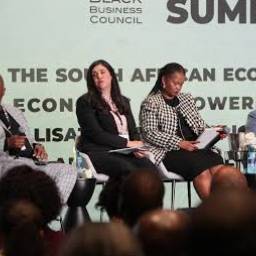
Reflections from the Black Business Annual Summit held on 12-13 August 2026, on political fragmentation, economic transformation, policy learning and what the universities need in the age of AI. I should clarify that I am not writing this as a political analyst. I approach these reflections as a policy analyst and transdisciplinary researcher. My interest is therefore not in determining which political party presented the best political argument, nor in judging their ideological positions. Rather, I am interested in what their different positions reveal about policy design, implementation, learning and the institutional conditions required for economic transformation. I am asking what happens when multiple policy ideas address different dimensions of the same structural problem but remain politically and institutionally fragmented.
The theme was “Growing the South African Economy through Economic Empowerment, Re-industrialisation and Localisation in the Era of Artificial Intelligence”, a topic that could hardly be more urgent for South Africa. Further to this, the theme was even more relevant because South Africa is approaching the local government elections in November 2026. And it is precisely why this debate is critical. I view voting as not merely a political preference; it is a decision about who we entrust with power, resources and the responsibility to shape the conditions in which our communities live.
Seeking Solutions Amidst Fragmentation
The summit brought together political leaders, business leaders and others who are concerned with the economic position of historically disadvantaged South Africans, including African, Indian and Coloured communities, as well as some African businesses from beyond South Africa. On the second day, political leaders were asked, a simple question yet complex: if your political party was given the opportunity to govern, what would you do to grow and transform the economy, and how quickly would you do it?
Listening to the responses, I found myself thinking less about which political party had the best answer and more about a question that I suspect we do not ask often enough: What happens when everyone has a piece of the solution, but nobody appears to own the whole problem?
The answers were remarkably different yet deeply interconnected. For instance, one party spoke about gender-based violence, dignity, and inequality, particularly within the Johannesburg metropolitan context. Another pointed to the deterioration of logistics infrastructure and the urgent need to revive the railway system. A third focused strongly on immigration law and enforcement, arguing that the country cannot expect people to trust and do business within a system whose own laws are not consistently enforced.
Yet another party put emphasis on industrialisation and manufacturing, with the argument that factories and productive industries are where innovation, value chains, and employment can be generated, alongside calls for improved financial transparency and land reform. Another voice advocated for ethical funding models, public procurement reform, and opening markets for small businesses.
A different perspective prioritised reliable access to basic services such as energy, water, and transport, particularly in townships and rural areas. Finally, another party offered an alternative take on how development should be measured, questioning an excessive dependence on quantitative targets and arguing instead for qualitative outcomes, sustainability, and interventions that ultimately allow people to stand on their own. None of these concerns are insignificant. In fact, they are deeply interconnected. And this is exactly where my discomfort began. Perhaps South Africa does not have a shortage of ideas.
The Interconnectedness of Structural Problems
We often speak about South Africa as though the problem is that politicians do not have solutions. The summit suggested something more complicated. Perhaps we have many solutions, but they exist in silos. For example, rail infrastructure affects manufacturing. Manufacturing affects employment. Employment affects household income and inequality. Energy affects industrialisation. Water and transport affect the ability of businesses to operate. Procurement determines who gains access to public markets. Land affects productive capacity. Immigration policy affects labour markets and social relations. Education determines whether young people possess the capabilities required to participate in these economic systems. Research and innovation influence almost all of them. All these are not separate problems. They are different dimensions of the same development problem. Yet our political system often encourages us to approach them as separate political projects, or we perceive them as distinct and separate entities.
Confronting Political and Developmental Priorities
This raises a difficult question: Can a complex structural problem be solved through fragmented political programmes, even when each programme contains legitimate elements of a solution? I am increasingly convinced that this is a question South Africa needs to confront. It is also why I found the call for political unity particularly interesting. South Africa's history has taught us about the devastating consequences of division. Apartheid was not merely a system of racial discrimination. It was also a system that institutionalised separation, fragmentation and unequal access to political, social, economic and geographic resources. The language of "divide and conquer" therefore has a deep historical resonance.
But perhaps the contemporary question should not simply be whether apartheid divided South Africans. The harder question is: After political liberation, did we sufficiently transform the institutional and political mechanisms through which that division reproduced itself? Have we changed the people occupying positions of political authority without sufficiently changing the systems through which power, knowledge and economic opportunity are organised? That question is uncomfortable precisely because it requires us to look beyond history without forgetting it. If political parties are for the people, what are politics for? The summit left me wondering about something even more fundamental. If political parties claim to represent historically disadvantaged South Africans, what happens when they cannot find common ground around the economic emancipation of the very people they seek to represent?
This is not an argument that political parties should become ideologically identical. They should not. Democracy requires disagreement. But perhaps we have confused political competition with developmental fragmentation. Political parties can disagree about ideology, markets, the role of the state, land, immigration, taxation and the appropriate form of governance. Yet surely there must be certain problems that are too deeply structural to be left entirely to partisan competition. Could we, then, disagree politically while cooperating developmentally? Could political parties agree that youth unemployment, industrialisation, infrastructure, education, energy, land, black enterprise, technological capability and research capacity require long term collective attention regardless of who wins the next election? If not, what exactly is politics for? Is politics primarily about governing society? Is it about representing constituencies? Is it about transforming society? Or, somewhere along the way, has politics also become about winning and retaining political power as an end in itself? These are uncomfortable questions because political parties are organisations, and organisations have their own institutional interests. What is good for a political organisation may not always be the same as what is good for the collective. Perhaps the real challenge is therefore not political disagreement. Perhaps it is our inability to convert disagreement into collective developmental action.
Policy Learning Over Policy Proliferation
From a policy context, the question is, do we need another policy, or do we need to learn from the policies we already have? There was another issue that kept returning to my mind. South Africa has no shortage of policies. We have strategies, frameworks, programmes, plans, targets and interventions. Governments change. Political priorities change. New administrations introduce new approaches. But where is the institutional memory? Where is the rigorous interrogation of what happened to the policy that came before? We need to become much more comfortable asking: What worked? For whom did it work? Where did it work? Under what circumstances did it work? Why did it work? Where did it fail? Why did it fail? Which parts should be retained? Which parts should be redesigned? I do not believe that an entire policy should automatically be discarded because it has not achieved everything it promised. Policies are rarely completely successful or completely dysfunctional. There are usually mechanisms within them that work in certain circumstances and others that do not.
The question should therefore be one of learning. Instead of constantly replacing policies, perhaps governments should become better at learning from policies. This is where academia has an important role to play. Research should not merely tell us whether a policy succeeded or failed. It should help us understand why, for whom, where, and under what conditions an intervention produces certain outcomes. This is the kind of thinking required when dealing with complex social and economic problems. And yet, our universities are often structured in ways that make this difficult.
The Role of Academia in Developmental Transformation
I then ask, what does academia have to do with all of this? The summit was primarily a political and economic conversation. But as an academic and transdisciplinary researcher interested in the relationship between policy, science, industry and young people, I could not help asking where the university sits within this picture. South Africa is asking business to innovate. It is asking government to transform the economy. It is asking industry to localise. It is asking young people to become entrepreneurial and technologically capable. It is asking society to prepare for artificial intelligence. But who is asking academia to transform? If there is a rule in place, who is responsible for enforcing it, and how is its implementation monitored and evaluated? Furthermore, how serious and urgent is the issue that the rule seeks to address? What does the university need to become if it is going to support this agenda? The university cannot continue to see itself simply as the place where knowledge is produced and then wait for government or industry to decide what to do with it. Nor should academia become an extension of government or business. Its independence is important. But independence should not mean irrelevance. The problems facing South Africa do not respect disciplinary boundaries. Neither does artificial intelligence. Neither does unemployment. Neither does climate change, food insecurity, water insecurity, industrialisation or inequality.
The Need for Transdisciplinary Scholarship
Why then are our academic systems still so heavily organised around disciplinary silos? Perhaps the academic of the future needs to be more than a specialist researcher. We need scholars who can move between science and policy, research and industry, universities and communities, evidence and implementation. We need people who can translate knowledge without diluting it. We need researchers who can work with government without becoming government. Researchers who can work with industry without becoming its servants. Researchers who can engage communities without merely extracting data from them. Researchers who can work with young people not simply as research subjects, but as participants in developing solutions. This is where transdisciplinary scholarship becomes more than an academic label. It becomes a developmental necessity. And that is why I consistently emphasise that postdoctoral fellows and early career researchers are particularly well positioned to lead this new era of academia. They are young, ambitious, energetic, adaptable, and often more willing to challenge established ways of thinking.
Artificial Intelligence and the Future of Knowledge
And then there is artificial intelligence (AI). The summit's emphasis on AI makes this conversation even more urgent. Artificial intelligence is not simply another technology that universities need to teach students how to use. It is changing the relationship between knowledge, labour, innovation and economic production. If South Africa wants localisation and re-industrialisation in an AI driven economy, then we need to ask whether our universities are producing the knowledge, skills, technologies and forms of collaboration necessary to make that possible. Who is producing the evidence that will tell government where AI can genuinely improve public services? Who is examining what AI will mean for township and rural economies? Who is asking which jobs will disappear and which new economic opportunities can be created? Who is examining whether AI will reduce inequality or reproduce it? Who is asking whether African knowledge will shape the technologies being deployed in Africa, or whether Africa will once again become primarily a consumer of technologies designed elsewhere? Who owns and controls the data and knowledge produced through AI, and how are ownership, intellectual property, access, and benefits distributed among the various actors involved in its production? These are not merely technological questions. They are questions of political economy, education, sovereignty and development. And this is why academia cannot remain outside the conversation.
Moving from Blame to Collective Agency
The Black Business Summit presented an unusual opportunity. There was something symbolically important about that room. The summit was explicitly concerned with the economic advancement of historically disadvantaged South Africans. In that space, the usual temptation to attribute every contemporary failure to somebody outside the room became more complicated. The history of apartheid remains fundamental. The concentration of economic power remains fundamental. Structural inequality remains fundamental. Historical exclusion cannot simply be wished away. But there was also something else in that room: political representation, business leadership, institutional knowledge and agency. That changes the question. At what point do we move from asking who caused the problem to asking what are we going to do with the agency we now possess?
A democratic society needs institutions capable of helping it learn. Universities should be among those institutions. They should be asking not only what governments intend to do, but whether it works. Not only whether a policy sounds progressive, but under what conditions it produces meaningful outcomes. Not only whether a programme reaches a numerical target, but whether it creates sustainable change. Not only whether innovation is technologically impressive, but whether it improves people's lives. And not only whether young people graduate, but whether the economy has created meaningful pathways through which their knowledge (and skills) can be used.
A Call for Unified Action
The challenges confronting South Africans are too complex for one political party, one government department, one business sector or one academic discipline to solve. They require many pieces. They require political courage. They require evidence. They require business. They require government. They require communities. They require young people. And they require an academia willing to leave the comfort of disciplinary boundaries and become a more active participant in the country's developmental questions.



Comments